Ayurvedic Massage: Customizing Treatment to Constitution in Private Settings
Ayurvedic massage is a therapeutic practice rooted in the five-thousand-year-old Ayurvedic tradition that customizes technique, pressure, oil selection, and treatment focus according to the individual's dosha — their unique constitutional type. Unlike modalities that apply a standardized protocol to every body, Ayurvedic bodywork begins with an assessment of who the person is before a single stroke is applied. Luxury Spa Therapists introduces practitioners trained in authentic Ayurvedic bodywork who understand how to read constitution through pulse, observation, and conversation — and then translate that reading into a treatment designed for one person alone.
Private settings are the natural home for this modality. Constitutional assessment requires unhurried time and a quiet environment. The therapist must observe the client's skin texture, energy level, speech patterns, and physical tendencies — details that emerge organically within a private residence but are lost in the compressed timelines of commercial spas. When the same therapist returns week after week, they track constitutional shifts across seasons, stress periods, and recovery phases, refining each session with an accuracy that no single appointment could achieve.
Understanding the Three Doshas
Ayurveda identifies three fundamental bio-energies, or doshas, that govern every individual's physiology and temperament. No person is purely one dosha — most carry a dominant type with secondary influences — but understanding the primary constitution determines how massage should be delivered.
Vata: Movement and Air
Vata-dominant individuals tend toward slender frames, dry skin, restless minds, and variable energy. When balanced, they are creative and quick-thinking. When aggravated — by travel, stress, cold weather, or irregular routines — they experience anxiety, insomnia, joint stiffness, and digestive irregularity.
Massage for Vata emphasizes warmth, grounding, and consistency. The therapist uses slow, rhythmic strokes with generous quantities of warm, heavy oils — typically sesame — applied in long, continuous movements that calm the nervous system. Pressure is moderate and steady; abrupt changes in rhythm or intensity disturb rather than soothe a Vata constitution. Sessions are longer, often ninety minutes, allowing the body sufficient time to absorb both the oil and the calming effects of sustained touch.
Pitta: Fire and Transformation
Pitta-dominant individuals carry medium builds, warm skin, sharp intellects, and natural intensity. In balance, they are focused and decisive. When aggravated — by heat, overwork, competitive pressure, or inflammatory foods — they experience irritability, skin inflammation, acid reflux, and a driven restlessness that differs from Vata's scattered anxiety.
Massage for Pitta is cooling and moderate. The therapist selects coconut or sunflower oil, which are naturally cooling, and avoids excessively stimulating techniques. Strokes are firm enough to satisfy Pitta's preference for purposeful work but measured enough to avoid generating further heat. The pace is deliberate without being sluggish — Pitta clients lose patience with work that feels aimless. Particular attention goes to the abdomen, scalp, and feet, where Pitta tension accumulates. Many Pitta-dominant clients benefit greatly from combining Ayurvedic massage with shirodhara, which cools the mind through sustained warm oil flow over the forehead — a pairing explored in depth in our guide to shirodhara in private settings.
Kapha: Earth and Stability
Kapha-dominant individuals possess sturdy frames, smooth skin, calm temperaments, and steady energy. In balance, they are grounded and nurturing. When aggravated — by inactivity, heavy food, damp climates, or emotional stagnation — they experience lethargy, weight gain, congestion, and a heaviness that pervades both body and mood.
Massage for Kapha is stimulating and invigorating. The therapist uses lighter, warming oils — mustard or safflower — applied in smaller quantities with vigorous, upward strokes. Dry brushing or powder massage (Udvartana) may precede the oil work to stimulate circulation and break up stagnation. Pressure is firm to deep, and the pace is brisker than for other constitutions. Kapha clients respond well to friction techniques that generate internal heat and encourage the lymphatic system to move fluid more efficiently — complementing the effects of lymphatic drainage when both are incorporated into a broader wellness programme.
The Role of Oil in Ayurvedic Massage
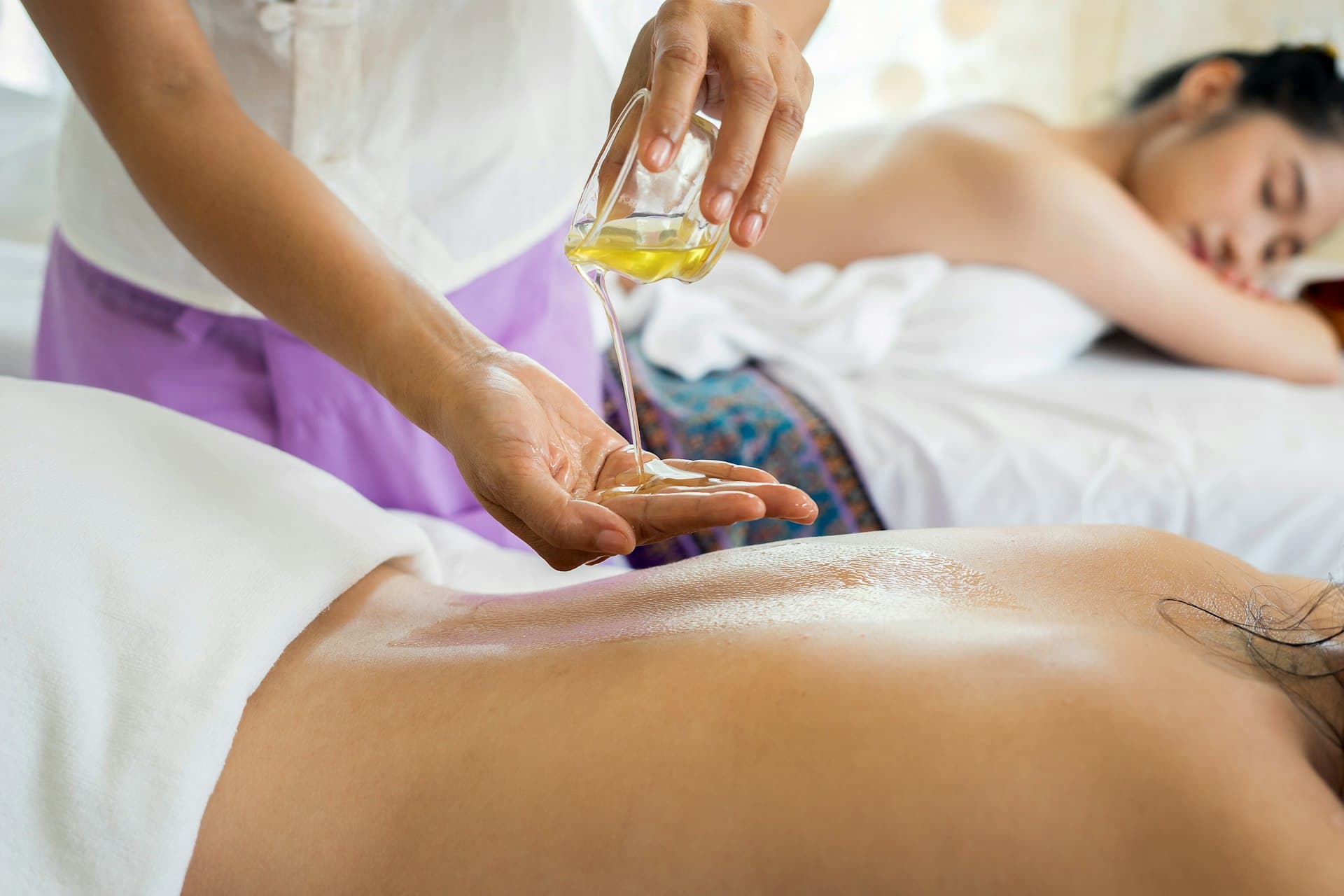
Oil is not a lubricant in Ayurvedic massage — it is medicine. The Sanskrit term for oil, "sneha," also means love, reflecting Ayurveda's understanding that the application of warm oil is itself a therapeutic act. The oil penetrates the skin, nourishes deeper tissues, and carries the properties of whatever herbs have been infused into it.
A skilled Ayurvedic therapist arrives with oils selected specifically for the client's constitution and current state. This selection process is detailed in our guide to choosing the right massage oil, though Ayurvedic oil selection adds a layer of constitutional specificity that goes beyond preference.
Sesame oil is the traditional default — warming, nourishing, and rich in antioxidants, it suits Vata and is considered tridoshic when heated. Coconut oil serves Pitta constitutions with its cooling properties and lighter viscosity. For Kapha, lighter oils or herbal powders replace heavy applications. Medicated oils — known as "tailam" — infused with herbs like Brahmi, Ashwagandha, or Bala over days or weeks deliver targeted therapeutic effects: Brahmi supports cognitive clarity, Ashwagandha builds resilience against stress, and Bala strengthens muscle tissue.
In a private setting, the therapist can maintain a dedicated oil selection for each client, adjusting seasonally and in response to changing conditions. This ongoing calibration is one of the advantages that a villa or private home provides over any commercial environment. For clients considering seasonal villa placements, our guide to villa therapist placement explores how this continuity is maintained across properties.
How Ayurvedic Massage Differs from Western Modalities
Clients accustomed to deep tissue massage or Swedish techniques sometimes approach Ayurvedic bodywork with expectations shaped by those modalities. The differences are foundational, not superficial.
Western massage traditions generally work from the outside in — identifying muscular tension, adhesions, or trigger points and applying techniques to resolve them. The treatment addresses what the therapist finds in the tissue during the session. Ayurvedic massage works from the inside out — beginning with the client's constitutional type, current imbalances, and therapeutic objectives, then selecting technique, oil, and approach to address the whole person rather than isolated symptoms.
The direction of strokes matters differently as well. Ayurvedic massage follows the body's energy channels (nadis and marma points) rather than solely following muscle fibre direction. Certain strokes move toward the heart to stimulate circulation; others move away to encourage lymphatic flow or energetic release. Marma points — the Ayurvedic equivalent of acupressure points — receive specific attention, with sustained holds that activate the body's innate healing intelligence.
This does not mean one approach is superior to the other. Many clients benefit from both. A weekly Ayurvedic session focused on constitutional balance can be complemented by periodic hot stones massage for deep muscular release or Balinese massage for its layered sensory experience. Our guide to Balinese massage in private settings explores how these modalities share philosophical ground while diverging in application.
Session Structure and Duration
A well-conducted Ayurvedic massage session in a private home follows a structure refined over millennia, adapted to the contemporary wellness context by therapists in our network.
Constitutional assessment. For new clients, the therapist conducts a thorough intake covering physical characteristics, emotional tendencies, sleep patterns, digestion, and lifestyle factors. Pulse reading (Nadi Pariksha) may be used by traditionally trained practitioners to confirm the dosha assessment. This intake takes fifteen to twenty minutes on the first visit and becomes progressively briefer as the therapist and client develop an ongoing relationship.
Preparation. The treatment room is warmed to a temperature appropriate for the client's constitution — warmer for Vata, cooler for Pitta, moderate for Kapha. Oils are heated to a precise temperature: warm enough to penetrate the skin effectively, never hot enough to cause discomfort. The therapist sets the space with deliberate simplicity — no competing fragrances or music unless the client specifically requests it.
Treatment. Abhyanga, the primary Ayurvedic massage technique, involves the systematic application of warm oil to the entire body using strokes calibrated to the client's dosha. The sequence typically moves from the scalp downward — head, face, neck, shoulders, arms, torso, back, legs, and feet — with specific attention to marma points throughout. Sessions run sixty to ninety minutes, though in private placements there is no constraint on extending to two hours when the treatment warrants it. Our full treatment menu details the durations and intensities available across all modalities.
Rest period. Ayurveda prescribes a period of rest following massage — ideally fifteen to thirty minutes — during which the oil continues to penetrate and the nervous system integrates the treatment. In a private home, this rest unfolds naturally; the client simply remains in their own environment, transitioning from treatment to evening without interruption.
Our placement process includes a trial session that allows clients to experience this structure firsthand. The trial session protocol ensures compatibility before any longer-term commitment. Our pricing structure includes the trial within the two-stage placement process.
Why Private Settings Elevate Ayurvedic Practice
Ayurvedic massage is inherently personal. The treatment is designed around the individual — their constitution, their current state, their environment. Delivering this level of personalization in a commercial spa, where therapists rotate and sessions follow forty-five-minute slots, diminishes the modality to its mechanical components while stripping away its diagnostic intelligence.
In a private residence, the therapist becomes a consistent presence. They observe the client across seasons — noting when Vata rises during autumn travel, when Pitta flares during summer, when Kapha accumulates during sedentary winter months. Each session responds to these shifts. The oil changes. The pressure adjusts. The focus migrates. This is Ayurvedic massage as the tradition intended: a relationship between practitioner and client that deepens over time.
The environment itself participates in the treatment. The client's own bedroom or dedicated wellness space becomes the treatment room, eliminating the physiological stress of travel and unfamiliar settings. Temperature, lighting, and sound are controlled precisely. The therapist can recommend dietary adjustments, herbal teas, or breathing practices to extend the treatment's effects into daily life — guidance that is practical only when the therapist understands the household's rhythm.
On a superyacht, Ayurvedic massage adapts to the maritime environment while maintaining its constitutional focus. The therapist accounts for the drying effects of sea air on Vata skin, the heating effects of sun exposure on Pitta temperaments, and the sluggishness that Kapha types may experience during extended time at anchor.
Who Benefits Most from Ayurvedic Massage
Clients seeking a holistic rather than symptomatic approach. Ayurvedic massage does not merely address a stiff shoulder or a tight lower back — though it does both effectively. It treats the pattern that produces the symptom, adjusting diet, lifestyle, and treatment focus to address root causes.
Individuals managing chronic stress. The constitutional framework gives the therapist a language for understanding how stress manifests differently in different people. Vata stress produces anxiety and insomnia. Pitta stress produces irritability and inflammation. Kapha stress produces withdrawal and lethargy. Each requires a distinct therapeutic response.
Clients interested in Ayurvedic wellness beyond massage. For those who have explored or are curious about Ayurvedic principles, having a therapist trained in the tradition provides a practical point of entry. The therapist becomes a guide — not a physician, but a knowledgeable practitioner who can contextualize the massage within broader Ayurvedic lifestyle recommendations.
Those who value continuity of care. Ayurvedic massage reveals its full depth over time. The tenth session with the same therapist achieves what no single appointment can. Clients who engage through our residential placement services find that the therapist's understanding of their constitution becomes increasingly precise, and the treatments increasingly effective.
Every therapist introduced through our network meets the seven pillars of selection and has been evaluated through the rigorous process detailed in our vetting standards overview.
To explore Ayurvedic massage as part of your private wellness programme, request a private introduction or connect via WhatsApp at +9613880808 to discuss your preferences in confidence.
Frequently Asked Questions
How does a therapist determine my dosha type?
An experienced Ayurvedic practitioner assesses your dosha through observation and conversation — examining physical characteristics such as bone structure, skin quality, and body temperature, alongside behavioural patterns like sleep habits, digestion, energy fluctuations, and stress responses. Some traditionally trained practitioners also use Nadi Pariksha (pulse reading), a technique that detects subtle constitutional signals through the radial pulse. The assessment refines with each session as the therapist observes how your body responds to treatment.
Can Ayurvedic massage address specific physical complaints like back pain?
Yes. While the modality approaches treatment constitutionally rather than symptomatically, specific complaints are addressed within that framework. A Vata-type back pain — characterised by sharp, mobile pain that worsens with cold — receives warm oil and sustained grounding pressure. Pitta-type back pain — presenting as inflammation and heat — receives cooling oil and moderate, non-aggravating strokes. The constitutional approach often resolves chronic issues that isolated symptomatic treatment has not, because it addresses the underlying pattern driving the symptom.
What is the difference between Ayurvedic massage and shirodhara?
Ayurvedic massage (Abhyanga) is a full-body treatment using warm herbal oils applied through systematic strokes tailored to your constitution. Shirodhara is a specific Ayurvedic therapy that involves pouring a continuous stream of warm oil over the forehead to calm the nervous system. The two are complementary — Abhyanga addresses the body while shirodhara addresses the mind. Combined in a single extended session, they represent one of the most comprehensive treatments in the Ayurvedic tradition.
How often should I receive Ayurvedic massage for meaningful results?
For general wellness and constitutional balance, two sessions per week provides strong cumulative benefit. Clients managing elevated stress, seasonal transitions, or specific imbalances may benefit from daily sessions over a one- to two-week intensive period, tapering to a maintenance frequency as balance is restored. Your therapist will recommend a rhythm based on how your body responds during the initial sessions and will adjust as your constitution shifts over time.
Is Ayurvedic massage suitable if I am unfamiliar with Ayurveda?
Completely. No prior knowledge is required. The therapist conducts the constitutional assessment and makes all treatment decisions based on their training and observation. Many clients begin with Ayurvedic massage as their first encounter with the tradition and find the experience both accessible and illuminating. The therapist can share as much or as little about the underlying philosophy as the client wishes — some prefer simply to receive the treatment, while others engage with the constitutional framework and apply it beyond the massage table.
What should I expect regarding oil on my skin and hair after a session?
Ayurvedic massage uses generous quantities of warm oil, which is intentional — the oil is therapeutic, not merely functional. After the session, the oil continues to nourish the skin for the duration of the rest period. Most clients shower thirty to sixty minutes later using a gentle cleanser. Scalp oil serves as a deep conditioning treatment and washes out easily. In a private setting, this post-treatment period is entirely comfortable; you remain in your own home with access to your preferred products and routine.
How does Ayurvedic massage complement other modalities in a private wellness programme?
Ayurvedic massage serves as an excellent constitutional foundation within a broader treatment schedule. It pairs naturally with shirodhara for combined body-mind treatment, with deep tissue massage for targeted muscular work on specific days, and with lymphatic drainage for detoxification support. The constitutional intelligence the Ayurvedic therapist develops also informs how other modalities are delivered — a Pitta-dominant client might receive lighter pressure during deep tissue work, for instance. Our team designs these integrated programmes during the initial consultation process.
For a confidential consultation about Ayurvedic massage in your private wellness program, contact us or connect via WhatsApp at +9613880808.
Discover our placement process to find the right Ayurvedic practitioner for your household.